
How to Delegate Tasks Effectively to Neurodivergent Staff: The CPORT Model
I had a manager say to me recently: "I told her exactly what I needed. She still got it wrong."
Turns out "exactly" meant a two-line Slack message sent between meetings. No context, no deadline beyond "soon," no sense of what "done" was supposed to look like. He wasn't being lazy — he was being efficient, or so it felt from his end. From hers, it was three sentences and a guess.
This happens constantly. You hand someone a task, you explain what you need, they go and do it. Simple.
Except it isn't, is it?
Most managers can point to a moment when delegation went sideways — a deadline slipped, the output wasn't what you pictured, or the task just never got started and by the time you followed up, three days had disappeared. It's tempting to draw conclusions about the person in that moment. That they're disorganised. That they weren't listening. That they need "more initiative." Nine times out of ten, though, the breakdown didn't happen with the employee. It happened at handover.
That matters for every manager, with every team. But if you're managing neurodivergent staff — Autistic employees, people with ADHD, dyslexic staff, or anyone else with a different cognitive wiring — it matters more, because the way a task gets handed over can be the difference between someone who thrives and someone who quietly struggles in silence. The good news: this isn't about lowering the bar. It's about being deliberate with a handful of things most of us do half-heartedly under time pressure — giving context, being specific about what "done" looks like, and putting it in writing.
This is where CPORT comes in — a five-part model for structuring a delegation conversation so nothing important gets left in your head. We'll walk through each part, then flip the lens for neurodivergent readers, because CPORT isn't just a manager's tool. It's just as useful as a way to ask for what you need, without it feeling like a special request.
What is the CPORT framework?
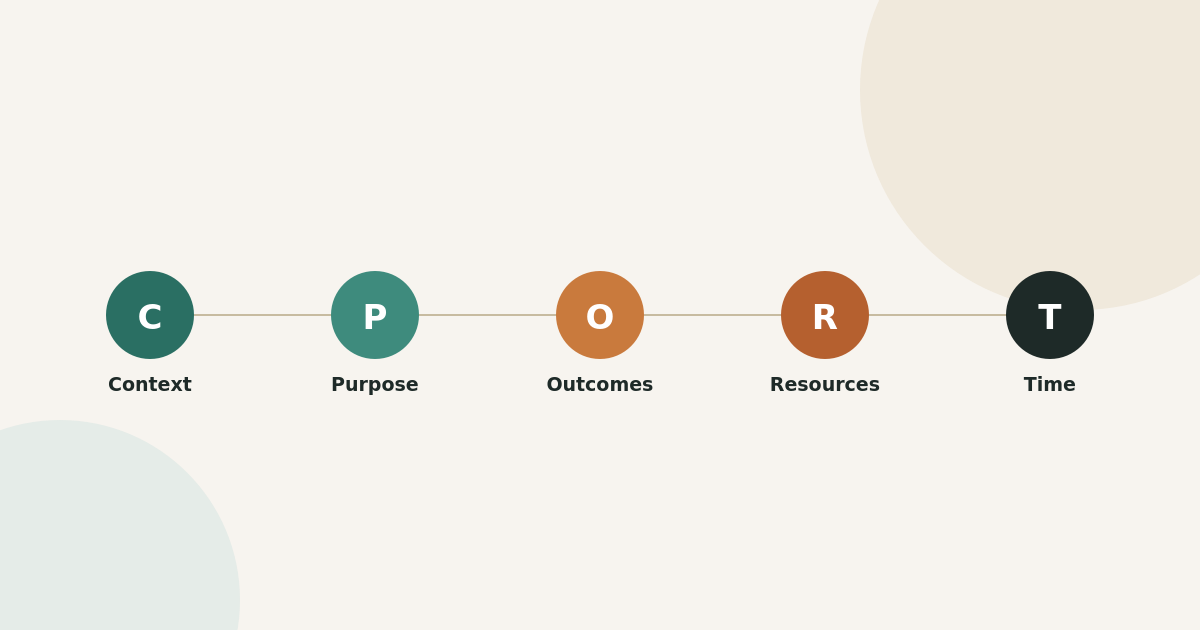
CPORT is a five-part framework for delegating tasks clearly: Context, Purpose, Outcomes, Resources, Time. Work through each one before you hand off a task, and you remove most of the ambiguity that trips up executive function — for neurodivergent employees, and honestly, for everyone else too.
Key takeaways:
CPORT is a five-part delegation model - Context, Purpose, Outcomes, Resources, Time - that helps managers hand over tasks clearly and completely.
Written instructions, alongside a verbal conversation, reduce the working-memory and ambiguity barriers many neurodivergent employees face.
Task initiation - simply getting started - is a distinct executive function challenge, separate from motivation or understanding.
Neurodivergent employees can use the same CPORT questions to self-advocate for clearer instructions from their manager.
Why task delegation goes wrong more often than we admit
Before the model — worth asking why this goes wrong so often in the first place.
Most delegation happens on the fly. A corridor conversation. The tail end of a meeting. A two-line message dashed off between other things. You've been sitting with this task for days, maybe weeks — you know why it matters, what "good" looks like, what's already been tried, and what the real deadline is versus the one you're quoting to build in a buffer. None of that lives in the other person's head. What feels to you like "a quick heads up" is, for them, the entire information set they've got to work from.
Add time pressure and the handover gets thinner still. Under stress we talk in headlines, not instructions — "can you sort out the quarterly report" instead of what it needs to contain, who it's for, what decision it's actually feeding. You're not being lazy. You're trying to be efficient. But efficiency at handover tends to show up later as inefficiency — clarifying questions, rework, or a task that just stalls.
For neurodivergent employees, thin verbal-only delegation compounds a few well-documented things:
Working memory load. A long verbal instruction asks the listener to hold several pieces of information in mind, then reconstruct them later — often from memory alone. Working memory is a genuine area of difficulty for many neurodivergent people, which means detail gets lost between the conversation and the desk.
Ambiguity and inference. Vague instructions ask the listener to fill gaps with what you assume is "obvious." Autistic communication research points consistently to a preference for explicit, literal language — and real difficulty guessing at unstated expectations.
Task initiation. The ability to begin a task promptly is one of the executive function skills most commonly affected in both ADHD and autism. It isn't about willingness. It's a specific cognitive bottleneck — and it gets misread as procrastination constantly.
None of this means neurodivergent employees need a lower bar. It means the handover — the moment a task moves out of your head and into theirs — deserves more precision. And precision, done properly, benefits the whole team, not just the people who need it most. Good adjustments for neurodivergent staff tend to just be good management, full stop.
What is the CPORT model for task delegation?
CPORT gives you a checklist to run through before you hand a task over — Context, Purpose, Outcomes, Resources, Time. Instead of delegating in a single breath, it asks you to slow down and make sure each of these five things has actually landed, not just been assumed.
Here's the shape of it at a glance:
| Letter | Focus | Core question |
|---|---|---|
| C | Context — the background and history | What does the person need to know about the background? |
| P | Purpose — why this task matters | Why does this task matter? |
| O | Outcomes — what a finished task looks like | What does "done" actually look like? |
| R | Resources — what's needed to do it well | What do they need to do this well? |
| T | Time — deadline and checkpoints | When is it due, and what are the checkpoints along the way? |
On its own, that's a decent general delegation tool. What we want to do here is look at each part through a neurodivergent-inclusive lens — the small adjustments that turn a good framework into an actually accessible one.
C is for Context
The question: What's the background? Why is this task landing now? What's already been tried, decided, or ruled out?
Context is the piece most managers skip, because it lives in their head as background noise rather than as information someone else needs. You know this report follows three failed attempts last quarter. You know the client raised it in a call the employee wasn't part of. You know exactly how sensitive a particular stakeholder is about this. None of that is visible to whoever's picking up the task unless you say it out loud — or better, write it down.
For a neurodivergent employee, missing context often shows up later as unexpected questions, or work that technically meets the brief but misses the actual point — because the point was never made explicit. It can also show up as anxiety: a sense of working in the dark, unsure whether a decision they're making might clash with something they simply don't know about.
In practice:
State the "story so far" in plain terms: what's happened, what decisions have already been made, and what constraints exist.
Name anything that's off the table, not just what's expected. ("We tried X last year and it didn't land well with the board, so let's avoid that approach.")
Don't assume prior meetings or conversations are common knowledge. If the employee wasn't in the room, summarise what's relevant from it.
A short written paragraph covering this, sent alongside or before the conversation, does more to prevent rework than almost anything else in this list.
P is for Purpose
The question: Why does this task matter? What's it in service of? What happens if it's done well - or not at all?
Context is the background story; purpose is the "so what." Understanding why a task matters supports sustained effort and better in-the-moment decisions, because the person can weigh trade-offs against the real goal instead of a guess at it.
This matters a lot for task initiation specifically. When a task feels arbitrary, it's harder to build the motivation to begin — and for anyone whose brain already works harder to generate that first bit of activation energy, a pointless-feeling task is far more likely to stall. Connecting a task to purpose isn't a soft extra. It's a practical lever that makes starting easier.
In practice:
Say plainly what this task contributes to. ("This report feeds directly into the board paper on resourcing, and the numbers you pull will shape whether we get sign-off on the extra headcount.")
Where possible, connect the task to something the employee already cares about or is good at. If you know a team member takes pride in accuracy, note that this task is exactly the kind of thing where that strength matters.
Avoid vague purpose statements like "it's important" or "the client wants it." Be specific about the actual stake.
O is for Outcomes
The question: What does the finished task actually look like? What standard are we aiming for? How will both of us know it's done?
This is arguably the highest-leverage letter in CPORT for neurodivergent staff, because it's where ambiguity does the most damage. "Put together some options for the client" can mean two completely different things to two different people. One hears "a rough draft to kick off a conversation." The other hears "a polished, presentation-ready document." Neither is wrong — the instruction just didn't specify, and each has now spent a wildly different amount of effort on a guess.
Vague outcome-setting is a very common source of what looks like underperformance but is actually a communication gap. Someone who produced something entirely reasonable, given what they were told, can end up confused or discouraged when it's rejected for not matching a mental picture you never actually described.
In practice:
Describe the finished product in concrete terms: format, length, level of polish, and who it's for.
Where you can, show an example. A past document, a template, or even a rough sketch of the structure removes far more ambiguity than a paragraph of description.
State explicitly what "good enough" looks like versus "gold standard," so the employee isn't guessing how much effort to invest, or over-polishing something that only needed to be a working draft.
Define what "done" means procedurally too - does finished mean drafted, reviewed, sent, or filed? Say so.
R is for Resources
The question: What does this person need in order to do this well? Tools, training, access, other people, time?
Resources is the part of delegation most likely to be assumed away entirely - "they'll figure it out" or "they can ask if they get stuck." For some employees, that's a reasonable bet. For others, particularly those who find it hard to ask for help or initiate a conversation about being stuck, an unstated assumption that they'll seek out resources themselves can leave them stalled without you ever knowing.
In practice:
Name the specific tools, templates, systems, or documents relevant to the task, rather than assuming the employee knows where to find them.
Flag who else is involved or who they might need input from, and whether you expect them to make that first contact or whether you'll make the introduction.
Ask directly: "Is there anything you'd need from me to get this started?" This is a more useful question than "do you have any questions," because it invites a practical answer rather than putting the onus on the employee to identify and articulate a gap in real time.
If specialised knowledge or training is required and hasn't yet been provided, don't delegate the task until that gap is closed, or build the training into the task itself with a realistic timeline.
T is for Time
The question: When is this due? What are the milestones along the way? How will progress be tracked?
A single due date, delivered without any sense of scale or checkpoints, asks the recipient to do their own project planning on top of the task itself - estimating how long each stage will take, working backwards from the deadline, and building in buffer for the unexpected. Some people do this instinctively. Others, particularly those with time-management or planning challenges linked to executive function, find this a genuinely difficult secondary task layered on top of the primary one.
In practice:
Give the final deadline, but also suggest or agree on interim milestones. ("First draft by Wednesday, so we've got Thursday and Friday for revisions before it goes out Monday.")
Be explicit about how much buffer is built into any date you give. If you're quoting Thursday because the real deadline is Friday, that's useful information for you but can create confusion, or a false sense of urgency, if the employee later learns the "real" date was different.
Agree on check-ins, not check-ups. A check-in is a scheduled, low-pressure point to review progress and troubleshoot; a check-up feels like surveillance. The distinction matters for trust, and for reducing the anxiety some employees feel about being monitored.
Ask how the person prefers to track progress - a shared document, a project management tool, a quick verbal update - rather than assuming your preferred method is universal.
Why written instructions matter for neurodivergent employees
Every element of CPORT above works better when it exists somewhere other than a single spoken conversation.
A verbal-only handover, however well structured, has two built-in weak points. First, it relies entirely on the other person's working memory — with no way to revisit the detail without asking you to repeat yourself, which plenty of people (neurodivergent or not) are reluctant to do more than once. Second, it gives them no time to process before they're expected to respond, ask questions, or start planning. Many neurodivergent people process language — especially spoken, in-the-moment instructions — more effectively when they get to read it, sit with it, come back to it, rather than parse and respond live.
This is why the most effective approach to delegation - for any employee, but especially for neurodivergent staff - combines both modes:
Write it down first, or write it down straight after. A short written brief covering the CPORT points doesn't need to be a formal document. A structured email, a message in your team's project tool, or a shared document is enough. What matters is that it exists somewhere the employee can return to.
Talk it through as well. The written brief isn't a replacement for conversation - it's a companion to it. A verbal discussion allows for tone, nuance, and immediate back-and-forth that a document can't fully replicate, and gives the employee a chance to ask questions in real time if they want to.
Give people time between the two. Where possible, don't require an instant response in the meeting where you first raise a task. Sending a written brief ahead of a conversation, or following up with one straight after, gives the employee the chance to read, reflect, and come back with informed questions rather than having to think on the spot.
This isn't about doubling your workload. In practice, a short written CPORT summary usually takes less time than it feels like it will, and pays for itself many times over in the rework and misunderstandings it prevents. It also leaves a shared record — useful for you when it's time to review progress or give feedback, useful for them as something to refer back to instead of reconstructing from memory.
Task initiation challenges: helping employees who get stuck before they start
Even with a solid CPORT brief in hand, some people will still get stuck at the very first step. Worth naming plainly, because it's one of the most misunderstood parts of managing neurodivergent staff — and one of the fastest places a manager jumps to the wrong conclusion.
Task initiation — starting without undue delay — is its own executive function skill, separate from motivation, capability or work ethic. Research into ADHD points to differences in how the brain's reward system responds to tasks without an immediate payoff, meaning a task can be fully understood, genuinely wanted, and still not translate into the first physical act of starting. In Autistic experience, something similar sometimes gets called "autistic inertia" — once still, staying still can take more energy to overcome than the task itself would take to finish, even when the person genuinely means to get going.
None of that means the task doesn't matter to them, or that they're avoiding it by choice. It means the gap between "I understand what to do" and "I have begun doing it" is, for some people, a real and separate hurdle.
Signs a team member might be stuck at the starting line, rather than simply delaying:
The task hasn't moved despite the employee having clearly understood the brief and having no other competing priority.
They seem to circle the task - opening the document, closing it, mentioning they'll "get to it" - without landing on a first action.
They express frustration with themselves for not having started, disproportionate to how "big" the task actually is.
The task involves an unfamiliar first step, an unclear entry point, or a lack of an obvious "smallest possible action."
Simple, low-effort things a manager can do:
Ask about the very first step, not the whole task. Instead of "how's that report going," ask "what's the very first thing you'll do when you sit down to start it." If they can't answer easily, that's often the actual blocker - the task hasn't been broken down into a concrete entry point yet, even if the overall goal is clear.
Offer to co-define the first step together. Rather than assigning "write the report," sit with the employee for five minutes and agree the literal first action - open the template, write the heading, list the three sections it needs. A task that starts as "open the document and write one sentence" is a fundamentally easier thing to begin than "write the report."
Offer a short, scheduled start-together session. Fifteen minutes at the start of a task, working alongside the employee (in person or on a call, cameras on or off, whatever suits them), can be enough to get momentum going. This mirrors what's sometimes called "body doubling" - the presence of another person working nearby, even without direct collaboration, that some people find measurably lowers the barrier to beginning. It isn't hand-holding through the whole task; it's a brief, deliberate nudge past the hardest part.
Reduce the ambiguity of the entry point specifically, separate from the ambiguity of the whole task. Even a well-written CPORT brief describes the destination. Some employees also need the first step spelled out as its own, separate instruction.
Normalise checking in early, not just at the deadline. A brief, casual check-in a day or two after a task is assigned - not to police progress, but to catch a stall while it's still a five-minute fix rather than a missed deadline - costs you very little and can prevent a much larger problem downstream.
Avoid framing a slow start as a character issue, even implicitly. Comments like "you just need to get on with it" rarely help, because the barrier isn't a lack of will. A neutral, practical question about the first step is far more useful than a comment about effort or attitude.
None of these strategies require special treatment or a different standard of accountability. They simply recognise that starting is sometimes the hardest part of a task, for reasons that have nothing to do with how capable or committed someone is.
Using CPORT to self-advocate for clearer instructions at work
If you're a neurodivergent employee reading this, CPORT is just as useful in reverse. You don't need to wait for a manager who already delegates this way. You can ask for the information you need, using the same five categories, without it needing to feel like a special accommodation request.
A few ways to bring this into a conversation with your manager:
When a task is handed to you verbally with little detail, ask for it in writing. A simple, reasonable request: "Would you mind sending me a quick summary of that so I've got it to refer back to?" This is a completely ordinary thing to ask for, and most managers will be glad to do it, particularly once they see it reduces the number of clarifying questions later.
If the purpose isn't clear, ask directly. "Just so I can prioritise this properly, what's this feeding into?" is a professional, entirely normal question that gives you the "why," which in turn can make it easier to get started.
If the outcome is vague, ask for a concrete picture of "done." "Is there an example of what this has looked like before?" or "Roughly how polished does this need to be at this stage?" are useful, low-friction ways to close the gap without needing to explain why you're asking.
If you're not sure what resources are available, ask before you start, rather than after you've stalled. "Is there a template for this?" or "Who else has worked on something similar?" are quick, reasonable questions.
If the timeline feels like a single, distant deadline, ask for it to be broken down. "Would it help if I sent you a rough draft by Wednesday so we've got time to adjust?" turns a vague deadline into a structure you can actually plan against.
If you know starting is likely to be difficult for you, say so in practical terms, rather than waiting until it becomes a problem. "I find it easier to get moving on things like this if I talk through the first step out loud - could we spend five minutes on that when you assign it?" is a specific, actionable request that most managers will find easy to say yes to, because it costs them very little and clearly benefits the outcome.
None of this requires disclosing a diagnosis or framing yourself as needing extra support. These are simply good delegation practices, and asking for them is a reasonable, professional thing to do - the same way anyone might ask for a meeting agenda in advance, or a written summary of action items after a call.
Frequently asked questions
What is the CPORT model?
CPORT is a task delegation model built around five questions to work through before assigning a task: Context (background and history), Purpose (why it matters), Outcomes (what "done" looks like), Resources (what's needed to do it well), and Time (deadlines and checkpoints). It gives managers a simple structure for delegating tasks clearly and completely, rather than relying on a single, thin, verbal handover. It forms a key tool in the tool box of an inclusive leader.
How do you delegate tasks effectively to neurodivergent employees?
Delegate tasks effectively to neurodivergent employees by putting instructions in writing as well as discussing them verbally, being explicit about context and purpose rather than assuming it's understood, defining exactly what a finished task looks like, confirming what resources and support are available, and breaking deadlines into milestones instead of a single distant due date.
Why do neurodivergent employees struggle with task initiation?
Task initiation is a distinct executive function skill - the ability to begin a task promptly - and it's commonly affected in ADHD and autism. Research points to differences in dopamine-linked reward processing in ADHD, and a related pattern sometimes called "autistic inertia" in Autistic experience, meaning a task can be fully understood and genuinely wanted, yet still be difficult to physically begin. It isn't a matter of motivation or work ethic.
Should instructions always be given in writing?
Written instructions should generally accompany, rather than replace, a verbal conversation. Writing things down reduces reliance on working memory, gives the employee time to process before responding, and creates a shared record both manager and employee can refer back to. A short written brief plus a conversation is more effective than either approach alone.
How can a neurodivergent employee ask for clearer instructions?
A neurodivergent employee can ask for clearer instructions using the same CPORT questions a manager would use: requesting a written summary of a task, asking what it's feeding into, asking for an example of what "done" looks like, checking what resources or templates exist, and asking for a deadline to be broken into milestones. These are reasonable, everyday requests that don't require disclosing a diagnosis.
Bringing it together
Delegation done well isn't about lowering expectations or adding a layer of extra process for its own sake. It's about recognising that a task only truly exists for the person doing it once it has actually been transferred - not when it's been mentioned, but when it has been understood clearly enough to act on.
The CPORT model gives you a simple structure to check that transfer has genuinely happened: have you shared the Context, explained the Purpose, defined the Outcomes, confirmed the Resources, and set out the Time? Putting this in writing, alongside a conversation, closes the two biggest gaps in delegating tasks to neurodivergent staff - reliance on memory, and reliance on inference. And paying attention to task initiation specifically - recognising that starting can be its own distinct hurdle, separate from understanding or willingness - means you catch stalled tasks early, with a light touch, rather than discovering them at the deadline.
None of this is exclusively "for" neurodivergent staff. It's simply good management practice, applied with enough precision that effective task delegation works for everyone on your team, including the people who need it most.
Want a structured way to build these skills across your leadership team? Our workplace services and neurodiversity training are designed to help managers put frameworks like CPORT into practice, with the coaching and support to make it stick. Get in touch to find out more.